

If after reading this you have any comments, please contact me. Thanks!
INTRODUCTION
HOW THE QUEST BEGAN
REVOLUTIONARY WAR PERIOD
AMERICAN CIVIL WAR PERIOD
WORLD WAR II PERIOD
ENGLISH CIVIL WAR PERIOD
MEDIEVAL PERIOD
ANCIENT PERIOD
COMMENTS
THROUGH A GLASS, DARKLY POEM
INTRODUCTION
I don't claim that any of the following personalities were actually my past lives because I have no proof. But the synchronicities (meaningful, timely coincidences) that seem to validate some of the cases are sometimes amazing.
My story will likely strike most people as preposterous, which I'm inclined to agree with, or some kind of narcissistic ego-trip. I can only say that I sympathize with that reaction. But what I got is what I got during this investigation and I present it here with a caveat that you can take it for what you think it's worth. I certainly won't mind. Even I find it hard to believe.
As you'll see, some of these proposed past lives included people of considerable, well-founded fame. They're a decided contrast with my present life of obscurity. Assuming any of these matches are accurate, which is by no means certain, it may indicate a difference in destiny or it may justify the notion that greatness is a product of how we meet challenges, and the bigger the challenges we meet, the greater will history regard us. I don't claim to share in any greatness that my alleged past lives garnered for I am a different person even if, perhaps, the same soul inhabited those bodies. We are all here to start over with every life.
Some people verify their past-life personalities by some combination of emotional reactions, visions, memories and dreams. I generally don't have such clues, so I tend to rely on what appear to be synchronicities for verification. Of course, the difficulty comes with distinguishing a synchronicity from a coincidence.
I should add that after I had been at my "hobby" (I call it "Soul Genealogy") of trying to identify my past-lives for a while, I saw a medium at a metaphysical chapel. Without prompting, the medium said that according to the spirits, I'm involved in a project having to do with discovery, and that information would bubble up so that everything would be revealed eventually. I was surprised that the medium would zero in, it seems, on my present "hobby", and so that tended to validate what she was saying. But it also led me to wonder why I should be given information on my past-lives. After all, that isn't normally done. The barrier between lives must be there for a reason. So why me?
One curious aspect of these cases is that my soul seems to have occupied two bodies (or perhaps more) at the same time in some lifetimes. That's not theoretically impossible and many sources indicate it's actually not that unusual for advanced souls. After all, the soul is just conscious energy and that should be divisible. In fact, according to Dr. Michael Newton in his books, "Journey of Souls" and "Destiny of Souls", his investigations involving regressing over 2,000 people to their life between life states indicate that we normally leave much of our soul energy on the other side when we reincarnate. How much we bring to Earth depends on what we are here to accomplish. That I would occupy two more or less famous bodies at once, however, suggests that mine is not a normal case. (If you're thinking I'm not normal, I assure you I am.) One alleged psychic who channels Yeshua (Jesus) claims that souls sometimes split and incarnate together to help advance the Earth. That may account for some of my incarnate combinations.
As for me, I'm smart enough to be a member of Mensa (at least 98th percentile in IQ tests), my Myers-Briggs personality is INTP (thinker), and I have a very wide range of interests. I've also traveled extensively.
HOW THE QUEST BEGAN
I never particularly cared who I might have been in previous lives, assuming they were all just as obscure and pedestrian as anyone else's. Every hypnotist will tell you that it is rare to encounter a client under regression who experiences being a famous person. But famous people reincarnate, too, and I have a theory that karmic patterns and carried over traits may result in more than one lifetime as a famous person. Those people who die before they were ready may try to resume their previous life and if that meant having been famous, they may try to duplicate it.
In all the hypnotic regressions I've done on other people, I've found two people who claimed to be someone that history has taken note of. The first experienced being the Biblical Mary, sister of Lazarus. It was the other one, however, who saw herself as someone historical (that she never heard of) that sparked my "hobby" to find out who I was in my past-lives. That's because she saw me as someone not just historical, but quite famous.
The subject was a lovely young woman (who wishes to remain anonymous). While she was under hypnosis, I asked, as I typically do, if she knew me in a previous life. She then regressed to what seemed to be the late 18th century or early 19th century and said she was watching the president give what she thought was an address in an outdoor venue. Then she exclaimed, “That’s you!” "I'm the president?", I asked, surprised. She affirmed it, so I asked who she was. She couldn’t remember the name, so I then asked who the president was and she couldn’t remember that name either. (That’s not unusual under hypnosis.) I asked what kind of speech it was, and she said she thought it was an inaugural address. So I asked what the president looked like, and she said he’s tall, lean, appears to be wearing a wig and from her description of his clothes, appeared to be dressed like they did back in the late 18th century. I then asked her about herself in that lifetime and she said she was a woman and married to a man she didn’t love. However, she was happy anyway because he was very rich even though he worked somehow for the government. I asked if she knew the president personally and she said they had met through her husband. They had two young children and lived in a mansion that had a marble staircase. She was so proud of that marble staircase, she mentioned it several times.
It took a lot of research to find out that there was only one house in the United States around 1800 that had a marble staircase and that it belonged to William Bingham, the richest man in the country at the time and eventually a US senator. William married his business partner Thomas Willing's 16 year-old daughter, Anne, and they eventually had two children. She was introduced to Thomas Jefferson in Paris, France, when she and William passed through while touring Europe and George Washington used to visit her Philadelphia house often. That's because Anne Willing Bingham was the premier American socialite of the time and her salon in Philadelphia was the hub of government socializing, especially for the Federalists. In addition to Washington, other founding fathers, such as Hamilton and Adams hung out there.
Interestingly, the Smithsonian Channel presented a show on the famous Lansdowne portrait of George Washington painted by Gilbert Stuart. The show pointed out that Washington was tired of having his portrait done and it was only when Anne Willing Bingham prevailed upon him to do a sitting for the Marquess of Lansdowne, a friend of her husband's, that Washington consented. That portrait is now probably the most famous of Washington's and is featured in the National Portrait Gallery's President's section.
Anyway, since the data points fit, I figured this young lady had been Anne Willing Bingham and the president that she claimed was me fit the description of either Jefferson or Washington. Madison was quite short and Adams quite rotund. Monroe fit the description, but he was president long after Ann Willing Bingham passed away.
My initial reaction to the possibility of being any of these giants of history was a feeling of surrealism and considerable doubt. I've done nothing in this life comparable to the accomplishments of any people listed below.
If you are a psychic reading this and have any ideas of your own as to the accuracy of what follows, or you have other proposed matches, please let me know. Meanwhile, please read on. What I've shown below presents how I arrived at my proposed past life matches and how I tried to verify them. I found that there seemed to be a pattern of being a military general and sometimes admiral and so I looked at those types who died not too long before another possibility was born. Or I looked into common dates. For example, if someone I think was one of my past lives was born in 1807, I'd look for others who were born in, say, 1707. Upon looking into the life of a proposed match, I'd see if there were any commonalities between my present self and the possible previous life. Then to verify it, I would ask the universe for a sign. Mostly nothing happened, but then, sometimes the synchronicity that occurred would be startling. Of those people listed below, the ones I had a sign for confirmation are in red type. Those I suspect were me but have no confirmation are in blue.


Ann Willing Bingham
1764-1801
REVOLUTIONARY WAR PERIOD
THOMAS JEFFERSON?
Thomas Jefferson was tall and lean, so my first thought is that it must have been him that the client saw. I’ve always had an affinity for Thomas Jefferson. From what I’ve read about him, our similarities go beyond a shared libertarian political philosophy. It turns out that virtually every aspect of Jefferson’s interests, capabilities, relationships, personality and character are similar if not identical to mine.
For example, I was telling a friend that when I worked at the Pentagon they were rearranging the traffic pattern around the building and in the process destroyed some of the old, stately trees that were on the grounds. One tree in particular really upset me since it was a huge, old tree that was literally ripped in half down the middle. I looked at it and felt terrible, as if it had been murdered. I kept apologizing to the tree every time I passed it. A week later, I was reading a biography of Jefferson and in it there was a passage about how Jefferson was lamenting the cutting down of the old, stately trees along the Potomac River, calling it murder and saying how he wanted to apologize to the dead trees. Coincidence or synchronicity? In fact, the more I read of Jefferson in that book (Thomas Jefferson: The Art of Power by Jon Meacham) the more I was astonished at how much Jefferson reminded me of myself.
However, that does not necessarily mean that I’m a reincarnation of his. I might have been an admirer of his, for example, who wanted to emulate him.
A reincarnation researcher, the late Paul von Ward did a study on the characteristics of Jefferson and myself. Initially, he said I had a strong case for being Jefferson. However, Paul was a believer in physical appearance being passed from life to life (through what he called psychoplasm) and eventually decided I don't look enough like Jefferson to have been him.
Seeking validation, I asked some psychics if I was Jefferson. All said yes, although one said I’m an aspect of his, claiming our soul can occupy nine different bodies and that one body can contain aspects of several different souls. That may explain why there are so many people claiming to be the reincarnation of Jefferson. (Sri Chinmoy is one.) Considering how many people claim to be the reincarnation of Jefferson, I'd say he's spreading himself a bit thin.
In any case, psychics sometimes tell you what they think you want to hear, so that is not the most reliable method of confirmation. While under self-hypnosis, I asked my higher self through idiopathic motor responses if I was Jefferson and received a yes. However, as I mentioned, we can easily delude ourselves if our ego is strong, so that isn’t necessarily conclusive either. Presumably, down deep, I wanted to be Jefferson's reincarnation because he reminds me so much of myself.
.As an aside, the "sleeping prophet", Edgar Cayce said that Thomas Jefferson had previously incarnated as Alexander the Great. It’s difficult to link characters as totally opposite as Alexander and Jefferson together, but I suppose things change over 2,000 years. Jefferson didn't seem very enthused about world conquest. Strangely, many years ago I acquired a key chain while visiting Greece that has the bust of Alexander the Great on it wearing the ram skin that represents the God Ammon. I’ve used it ever since (until keys became obsolete) because I've always been fascinated with Alexander. So, I asked for a sign that I was Jefferson and Alexander and the next day while going through a box of old Soviet Union military pins in a militaria antique store (I love antique stores) came upon a Thomas Jefferson commemorative coin. Going to another antique store the next day, I came across a brass bowl that has a silver portrait of Alexander the Great in it that matches the one on my key chain. Was that coincidence or synchronicity?


Thomas Jefferson Me
1743-1826
However, further research indicates that Jefferson only made two public speeches and those were both indoors. He also rarely wore a wig. What's more, I've read three accounts regarding Anne Willing Bingham's demise. One said she caught "lung fever" while in Europe and another said she caught some illness while out sleigh riding near her Philadelphia home. Yet another account said she gave birth to a third child in 1800 and was so sick that she was put on a ship to go to Bermuda in hopes the climate would help her recover. She died in Bermuda in May 1801 and is buried there. In any case, what these indicate is that if she died two months after Jefferson was inaugurated in March 1801, she was probably too sick to have been at the ceremony even if she wasn't in Bermuda or on a boat.
GEORGE WASHINGTON?
This leads me to believe that the president she said she saw as me had to be Washington, who did, indeed, make his inaugural speech on an outdoor balcony in New York in 1789 when Anne would have been well with two young children (they would have been grown in 1801 when Jefferson was inaugurated) and easily in New York with her well-connected husband. Washington also rarely wore a wig, but his gray hair made it seem like he was wearing one.

George Washington's First Inaugural
So I'm left with the conundrum that by affinity and other indications, I was Jefferson, but the only observer I've encountered, even if under hypnosis, indicates I was Washington. Of course, saying you're the reincarnation of Jefferson or Washington may lead some to question the size of your ego or maybe your sanity, regardless.
What Washington actually looked like is open to question if you compare all the portraits that were done of him. They differ wildly in appearances and typically look more like the artist who did the painting than George. However, a reconstruction of his face was performed by forensic experts and that image looks a lot more like me than do portraits of him, or for that matter, images of Jefferson.


George Washington Me
1732 - 1799
Taking another tack, I asked the universe for a sign that I was Washington and wondered how that would appear considering how many real signs there are around Washington, DC, where I lived at the time, with Washington on them. But proving that the universe is resourceful, my wife and I were driving along while she was reading a book. As I was literally wondering where a sign might appear, she said, "Did you know that Denzel is a Quaker name?" I immediately thought of the only person I know with that name, Denzel Washington. Coincidence or synchronicity?
In May, 2011, I still wondered if I was Washington in a previous life because it seems so improbable. Before going to bed, I asked the universe to give me a dream about Washington if he was, indeed, me back then. That night I dreamed about the name George Washington all night long. (If someone shows up in my dreams, I usually experience the name but associate it with abstract things.) That's highly unusual for me because I've asked for that kind of verification before and my brain just did its own thing anyway. If a possible past-life shows up, it's spontaneous rather than my request. Was it a sign?
Although overshadowed by Jefferson's interests, Washington has recently become known as a person greatly interested in art and architecture, as well as innovations. He had more of a hand in designing Mount Vernon than has been usually surmised. In fact, he collected paintings and was one of the first Americans to concentrate on landscape paintings. Most of my photos are of landscapes, reflecting my love of nature.
In February 2013, I thought to myself, "I greatly admire and respect Washington, but I love Jefferson." The next day, I opened a new biography of Jefferson I bought and looking at a picture of George Washington, the caption read, "Jefferson admired and respected Washington, but he didn't love him." Synchronicity?
Although it's hard for me to believe I could have been either of these two giants of American history, the possibility of having been both is even more perplexing. But it may be that my soul was in both of those founders.
DAVID HUMPHREYS?
So, what if I weren't Washington? In December 2011, a psychic said, off the bat, "You have a warrior mentality", and then said I was a member of Washington's army. She said I was an aide to the general and a close friend, read maps and acted as a liaison with foreigners. I believe that description could refer to David Humphreys, an aide and close friend of Washington's.
Humphreys was a graduate of Yale University and for a while was a school principal and teacher. I once had a hypnosis client say she saw me teaching her in a past life. In 1776, he joined the Continental Army and came to the attention of Washington. Rising to the rank of Lt. Colonel, Humphreys was on the staff of several generals until winding up with Washington in 1780. Washington was highly complimentary of Humphreys and when the General went from Virginia to New York to become president, it was Humphreys who accompanied his close friend. In fact, after the battle of Yorktown, it was Humphreys who was chosen to present all the captured British flags to Congress. After the war, Humphreys lived with Washington at Mount Vernon for 18 months and started the only authorized biography of Washington ever written. During Washington's presidency, Humphreys became America's first diplomat, being assigned as Ambassador to Portugal and later Spain. In later years, Humphreys wrote poetry (something I've done in this and other past-lives) and became an entrepreneur, starting a factory that employed boys that Humphreys ensured would also receive a good education. He is also the father of America's woolen industry, introducing the Merino sheep to this continent. Humphreys died in 1818. In many respects, even looks, Humphrey reminds me of William Rosecrans (see below) who was born in 1819. However, I have no real reason to believe that Humphreys was one of my past lives.


Humphreys Me
THADDEUS KOSCIUSZKO?
Another possibility is Kosciuszko. I read a biography of Kosciuszko, and he reminded me of another of my possible incarnations, William Rosecrans (see below). Like Rosecrans, Thaddeus was a military engineer, and he helped the American army tremendously during the Revolutionary War. He was also a fearless commander who led from the front, especially after he returned to his native Poland, and twice led an uprising against the occupying Prussians and Russians. Thaddeus was also quite artistic, going to an art academy in Paris when still young. He even wrote music. He had the same personality as Rosecrans and the others I might have been, being very egalitarian, affable, humorous and kind. He was a close friend of Thomas Jefferson and John Laurens, sharing their commitment to republican principles. In his will he left his funds under the care of Jefferson to buy and free slaves as well as educate them. Rosecrans (see below) was the superintendent of a Sunday school for black children when he was stationed in Washington, DC. When Kosciuszko was building the fortifications at West Point, he found a spot on a mountain top, planted it with flowers, and used to go there to meditate. Likewise, von Stauffenberg (see below), another possibility of mine, had a spot on a mountain top near his home that he used to go to for his meditations.
I went to a Kosciuszko elementary school as a child and after I moved to the Charlotte area, I had a black handyman helping me out who mentioned he was born in the same town as Oprah Winfrey, Kosciuszko, Mississippi. He was surprised that I knew who Thaddeus was. So, figuring this might be an indication that he was one of my past-lives, I asked for a sign. Nothing happened for a couple of weeks. Then one morning I had a picture of Thomas Jefferson on my computer screen, and calling over my wife to see it, I mentioned that the fur collar Jefferson was wearing was given to Kosciuszko by the Czar of Russia, who then gave it to his friend, Jefferson. My wife's eyes grew wide and she exclaimed, "I forgot to mention that when I woke up this morning, the name Kosciuszko was going through my mind. Wasn't he associated with some American war, like the Revolution or the Civil War?" I was amazed. Coincidence or synchronicity? By the way, my wife's Polish maiden name ended in ski. Most of my friends back in heavily Polish Detroit had a ski at the end of their names, too. I don't think Kosciuszko resembles me, but given the synchronicity, it's also possible that he was one of my wife's past lives.


Kosciuszko Me
1746 - 1818
ALEXANDER SUVOROV?
I went to bed one night in October 2015 and before going to sleep, asked to have a dream about my past lives. I had been having vivid dreams lately so I decided it was an opportunity and, indeed, I did have a dream. In it, a psychic, who I thought wasn't very good, showed me a diorama of something like toy soldiers. I looked at it and said, "Napoleon?" The psychic laughed. I looked again and saw a flag that I thought must be Serbian. Then the name Suvorov kept going through my mind. After waking, I realized the flag I saw was Russian, and the name Suvorov sounded familiar, but I had no idea who that is or was. Looking up the name, I found Alexander Suvorov. He was born in 1730 and lived until 1799, which is almost exactly the same years of George Washington's life. Suvorov was Russia's last Generalissimo, a rank above even a Field Marshall, and is considered one of history's greatest generals. He never lost a battle in over 60 major engagements, even when badly outnumbered, against foes in the Seven Years War, two wars against the Ottoman Turks, the new French Republic and even Kosciuscko's Polish rebellion. (Which reminds me of how my past incarnations as Rosecrans and Lee were on opposite sides of the Civil War.) Suvorov was a tactical genius using unconventional methods and even wrote a book on how to achieve victory. Despite that, he was also modest, sleeping and eating on the battlefield in the same conditions his troops did, whom he called "brother" regardless of rank. He also considered generosity towards his defeated foes and civilians to be essential. Coming from a lower class aristocratic family, and with his scrawny appearance, he never quite fit in at court. But he didn't support revolutionaries. Suvorov doesn't look like me, nor do I have any particular affinity towards Russia. I don't think he was one of my past lives, but still, why did I have that dream?

ALEXANDER SUVOROV
1730 - 1799
AMERICAN CIVIL WAR PERIOD
Since this was now a hobby, I decided to see who else I might have been after I came up with Washington/Jefferson and who knows who else possibility. Sometime after that, I attended a platform medium reading. For some reason, no spirits showed up for me but the medium gave me what I presume was more of a psychic reading. She looked at me and said, "Gettysburg," then asked if I'm a reenactor. I'm not. On two previous occasions, the first thing a psychic said to me was, "Gettysburg." Could it be that most people only know the name of one battle in the Civil War and thus always come up with Gettysburg? Or did I have something to do with that battle? I've been to Gettysburg many times but never had any emotional feelings about it.
(The same medium said the words Curtis and Edward were coming to her, and then exclaimed "Edward Curtis!" I had no idea who that is, and apparently, she didn't either. Then a member of the audience said that Edward Curtis was a famous photographer who took pictures of American Indians. I'm not sure what that would have to do with me. I looked him up and I didn't see any correspondences, although I do enjoy making artistic photographs. He also died four years after I was born. Maybe Edward Curtis showed up for the session.)
ROBERT E. LEE?
Later, I asked another psychic who I might have been in the Civil War. She said I was wearing blue and was a general on the losing side. I didn't know what to make of that. She said that the general felt hugely responsible for the loss of the men under his command and it bothered him for the rest of his life. She thought at first that it was Robert E. Lee, but then decided it was someone associated with him. (Because psychics are frequently accused of telling clients that they were someone famous in a past-life, I suspect many are loathe to actually name someone famous.) Lee was, indeed, sorrowful about the loss of his men, especially after Pickett's charge at Gettysburg. In any case, she said that I have the same eyes now as I had then. Could it have been Robert E. Lee, his brother Sidney, or was it one of his sons or even his nephew, Fitzhugh?
I was stopped at a traffic light and noticed a bumper sticker on the car in front of me. It advertised a tavern and upon squinting my eyes, I could barely make out the fine print giving its location, that is, Hanovertown, Virginia. Later that evening, I was reading a biography of Confederate General Fitzhugh Lee, the nephew of Robert E. Lee, and found it mentioned him participating in a battle at Hanovertown. General R. E. Lee had sent General Hampton and his cavalry there, including Fitzhugh Lee, and they ran into Federal cavalry. Coincidence or synchronicity?


Fitzhugh Lee W.H.F. Lee G.W.C. Lee
1835 - 1905 1837 - 1891 1832 - 1913
Robert E. Lee married the great-granddaughter of Martha Washington and some say actually modeled his behavior after George Washington. Virginia governor Wise told Lee that he played Washington perfectly. In any case, the two are so similar that even President Woodrow Wilson said Robert E. Lee was Washington reborn.
Lee and I share certain traits. In fact, he reminds me a great deal of myself in personality and character. He was very kind, generous and gentle. Although he was emotional and could have a volcanic temper, he avoided showing his emotions. In that respect, he was like Washington. Most of the time, especially in public, he was reserved, dignified and calm, leading some to call him the "Marble Man." But especially in private among friends and family, he was also playful, had a great sense of humor and loved to make puns. If he wronged someone he went out of his way to make amends. He avoided personal confrontations with people which some say led him to retain incompetent subordinates. If he had to scold someone, he did it gently and usually indirectly. (Those were also traits of Jefferson's.) Lee also had a need to be independent and actually preferred to be alone or at least not under the authority of others. But he also had a need for security, so ironically, he chose a career in the Army. Lee also had the kind of temper he held under control but on a rare occasion it would erupt. He was also quite impatient. Lee did not drink or use tobacco, nor did he cuss or use profanity. Lee had a keen sense of personal honor and strongly believed in doing your duty. He was highly spiritual and had, like Washington, a providential view of God. He didn't think your religion was as important as your spirituality, which is also my belief. Lee was very punctual and hated routine. Lee read non-fiction, primarily history and biographies, but also a wide range of other subjects. People were sometimes surprised that he could converse intelligently on virtually any subject. His favorite subject in school was astronomy. (When he was tasked with surveying the boundary between Ohio and Michigan his title was "Assistant Astronomer.") He also disdained "office politics" and deeply resented people who used politics to get ahead instead of merit, which only slowed his own advancement in the peacetime army. Lee was widely admired as a soldier, including by the commander of the Army, Winfield Scott, but that did him no good in terms of getting promoted. Lee dearly loved animals and treated even his horses as members of the family. He had a special affinity for women and girls, admiring their gentleness, so he preferred them as friends rather than men. He loved to flirt, treated women as women and, though he was devoted to his wife, seemed to have a need to develop platonic friendships with the beautiful ones. (His wife understood.) As an example, from 1832 to 1835 the wife of one of his close friends and fellow officers, Harriett Talcott, was a close friend. He called her "My beautiful Talcott." Amazingly to me, all of these characteristics of Lee are identical to mine. About the only trait of his that I don't normally share is that he was a perfectionist.

Harriett Talcott
Lee's father, the famous Revolutionary War cavalry commander, "Light Horse Harry" Lee, eventually ran into financial trouble, was sent to debtors prison and after being injured in a riot, fled abroad where he died. Young Lee barely knew his father except by reputation and the damage he had done to the family name. In that respect, Lee and I had similar paternal troubles, since my father, who I knew mostly by reputation as a genius and criminal, was always in legal and financial trouble. He died long after he and my mother divorced and I rarely saw him.
I went to the Monroe Institute for their week-long course called Gateway Voyage. The night before I left for the institute, I had dreams of Robert E. Lee all night long. Then, in my first session at the institute, I had an eidetic image of Robert E. Lee appear in my mind.
To make matters even more confusing, after I returned home, I asked my higher self under self-hypnosis who I was during the Civil War and saw an image of a man in a blue uniform putting on the skin of a dead lion, complete with head. (That was also a common image of Alexander the Great as Hercules.) I didn't know what to make of that, so I asked to be given a sign as to whether I was Robert E. Lee. That night, I picked up a biography of Lee and read where one of his contemporaries remarked that some Confederates, unlike Lee, tried to wear the lion's skin without first killing the beast. The author kept referring to Lee as "leonine." Lee also wore US Army blue, and was a courageous hero in the Mexican War, before reluctantly joining the Confederate side in the Civil War. When Lee met Grant in the aftermath of Appomattox, he wore his old blue army coat. So was all that coincidence or synchronicity?
When I first contemplated being a reincarnation of Lee and asked for a sign, I walked into a book store and found myself looking at a magazine cover featuring a picture of Lee. I thought that was a weak sign, if at all. (It's generally not a synchronicity, in most cases, if you would have seen it anyway. But timing may indicate a sychronicity.) More than a year later, I asked for a sign and walked into another book store to spot a picture of Lee on the cover of a magazine. In between, I saw no pictures of Lee. So maybe it is a sign!
I've had people tell me I look a lot like Lee.


Robert E. Lee Me (1969)
1807-1870
Lee Me (c. 1978)
According to various sources, we tend to incarnate with the same set of souls, as sort of repertory company who assume different roles with each other in each lifetime. Some people try to determine if their relatives or friends look like people associated with their past-lives. In the case of Robert E. Lee, my son reminds me of Lee's nephew, Fitzhugh. My son's former partner and friend looks a lot like Lee's eldest son, Custis, and has certain commonalities with him. My daughter looks just like Fitzhugh's wife, Ellen Fowle Lee.

My son and Fitzhugh Lee, nephew of Robert E. Lee

My son's friend and George Washington Custis Lee, son of Robert E. Lee

Ellen Fowle Lee, wife of Fitzhugh Lee, and my daughter.

My wife and Mary Custis Lee, the wife of Robert E. Lee
In February 2012, it dawned on me that I lived for 25 years in the "Lee's Crossing" subdivision (apparently commemorating his crossing of the Potomac), in Chantilly, Virginia, Fairfax County, with a school next door called Lee's Corner. In fact, the Lee's used to visit a cousin whose estate in Chantilly, Virginia once bordered the house I lived in. What's more, where Lee was born, Stratford Hall, is next door to the estate of Richard Henry Lee, called Chantilly. Lee and his family also visited and sometimes lived in the Ravensworth mansion in Fairfax County not far from where I lived. Lee and his wife also spent summers at Warm Springs, Virginia, where they rented a cottage . Mary used to swim in the baths there trying to cure her rheumatism. I, too, swam in those baths while taking a hypnosis course at a local B&B. Moreover, Lee lived in Detroit, Michigan, when he was surveying the boundary between Michigan and Ohio. Detroit is my home town.
I also had a psychic tell me I was Robert E. Lee's brother. He had two. One was a farmer and unsuccessful writer, and the other was a briefly famous naval officer, Sydney Smith Lee. Sydney was noted for commanding Admiral Perry's flagship when he sailed to Japan and for being Commandant of the Naval Academy in Annapolis at the same time his brother Robert was Superintendent of the Military Academy at West Point. Sydney was actually considered more handsome than Robert and was more convivial. At one point, after Union forces had taken the Confederate naval facilities at Norfolk, Sydney arranged for all the equipment and personnel, along with himself, to relocate to Charlotte, North Carolina, where I now live. Could I have been Sydney instead of Robert? I think I look more like Robert and Sydney was never at Gettysburg or regretted the loss of men under his command.

Sydney Smith Lee
Interestingly, his family nicknamed Sidney "Rose." Anyway, I think the odds of having been Robert E. Lee appears to be quite strong. But I have yet to have a convincing synchronicity to confirm it, at least in my mind.
WILLIAM S. ROSECRANS?
So, to add to the confusion, I had a psychic say that I was a Union officer whose name started with something like "rose." I had no idea to whom he was referring. However, several weeks later, I woke up one morning to find the word "Rosecrans" going through my mind. That was followed by "Nashville." I looked up Rosecrans and found he was a Union general who fought mostly in the western theater. Nashville was where the Army of the Cumberland, which he commanded, was headquartered. Rosecrans was in many ways similar to Robert E. Lee and the two met and corresponded after the war. Interestingly, one of the first encounters of the Civil War was in western Virginia (now West Virginia) where in July 1861 Robert E. Lee faced off against William Rosecrans, and Rosecrans won, driving the Confederates out of what would become West Virginia in 1863. That was a low point for Robert's career as a Confederate general.
Rosecrans also had some things in common with me, including an interest in architecture, engineering, mining and geology. Before the war, he was an engineer and helped build the Washington, DC, Navy Yard, where I used to work occasionally. I used to work as an engineer at General Motors and as a civil engineering technician. He also helped find and develop the Kanawha coal field in West Virginia, in the same area that George Washington used to own land. Both Washington and Rosecrans were entrepreneurs who were trying to become wealthy. Washington was forever speculating on land in "the Ohio country" and also owned land fairly near to where Rosecrans was born. I did my geology field work in the Appalachians of Virginia and West Virginia since I was interested in the economic geology of the area. Most of my classmates went out west.
After the war, Rosecrans became involved in mining ventures in Nevada. As for me, exploring old mines, especially in Nevada and the west is one of my favorite activities. Rosecrans eventually moved to southern California and owned land in the south Los Angeles area, where I once lived, and in San Diego, where I also lived. Rosecrans later represented California's first congressional district (San Francisco at the time), living near to where my twin brother now lives. He was also appointed ambassador to Mexico and was instrumental in trying to get Americans to invest in Mexican railroads. At the Defense Intelligence Agency, I was once assigned to study the infrastructure of Mexico while with the Military Geography Branch. (During the Mexican War, Capt. Robert E. Lee expertly used his knowledge of military geography to find ways of flanking the Mexican army.)
Later, I asked for a sign as to who I was in the Civil War and soon found myself parked next to a car that had a license plate reading, "4ROSY." Rosy is what everyone called Rosecrans. Then, a bit later on the same day, I saw a U-Haul trailer pull alongside my car with a pictorial of Redondo Beach on the side. That's where Rosecrans lived in his later years and where he died. A couple of weeks later, I was heading to Richmond, Virginia to see a Civil War show. I asked again for a sign that I was Rosecrans. As I sat in the bumper to bumper traffic on I-95 for hours, a car came up on my right. The license plate said, "4ROSY." It was the same car. What are the odds of that happening? Coincidence or synchronicity?
A couple of years later, I was thinking about the possible Rosecrans connection when a car with a U-Haul trailer came along side me on the freeway. The trailer had "Redondo Beach" on the side of it. I rarely see U-Haul trailers (although lots of trucks and vans), but the next day, I saw another U-Haul trailer with "Point Pleasant" on the side of it. Point Pleasant, Ohio, is the town in which Rosecrans' nemesis, Ulysses S. Grant was born. Strange.
Interestingly, when Rosecrans was a child, he borrowed a copy of Jane Porter's historical novel, "Thaddeus of Warsaw", whose title character was Thaddeus Kosciuszko. He read almost all 450 pages only to find the last few pages missing. He was so enamoured of the story that he worked in his father's store for three months to earn enough money to buy his own copy of the book so he could finish reading it.
I also tried to program my dreams one night to see if my Civil War identity would pop in. All I recall from a dream that night was myself saying, "I have a letter from Hazen." That would probably be William B. Hazen, one of Rosecrans' subordinate generals and a hero at the battle of Stones River. Of course, Hazen could have sent a letter to anyone, but Rosecrans seems the most likely.
In any case, I do look a bit like Rosecrans, who is shown here at various stages in his life. He also looked like some portraits of Washington.


William Rosecrans My Twin Brother
1819-1898

Rosecrans Me


Rosecrans Me


Rosecrans Me
I once had a girlfriend back in 1968 who shall remain nameless. Interestingly, she looks like the wife of Rosecrans, Ann Hegeman Rosecrans. Notice the nose and eyes.

Ann Rosecrans Former Girlfriend
Washington used to own tens of thousands of acres along the Kanawha and Ohio rivers in what is now West Virginia. After the Revolutionary War, he visited his holdings to ascertain their economic value, including a visit to a coal mine. Then Washington became obsessed with creating a lock and canal system to link the Potomac and Ohio rivers. Rosecrans was involved in coal mining along the Kanawha River and founded a company to create locks and canals to transport coal by water. Rosecrans was an engineer and inventor, holding several patents. Washington used his farm as a laboratory to experiment with various ways to better the soil and find more efficient ways to farm.
While working for the Defense Intelligence Agency (DIA) during the first Gulf War in 1991, I unraveled the entire Iraqi water control system of locks, dams and barrages so as to explain how they might be manipulated to flood the approaches to Baghdad.
Interestingly, when Rosecrans was re-interred at Arlington Cemetery in 1902, President Theodore Roosevelt gave a eulogy in which he stated that the great works of George Washington would have crumbled into the dust if it weren't for the efforts of Rosecrans and his men.
I'm reasonably convinced I was Rosecrans and Lee. The two met after the war when Rosecrans enlisted Lee's help in trying to defeat Grant's bid for the presidency. It seemed from my other past-lifes that I incarnated to help bring about liberty and human progress, so I wondered why I would incarnate as Lee, who was, after all, fighting to establish a country that was trying to preserve slavery. I came to the conclusion that if it weren't for Lee, the south would have lost very quickly, and the union would have been preserved according to the status quo, with slavery intact. His success on the battlefield eventually forced the war into a different moral rationale, that is, ending slavery. Interestingly, I later read a book that made the same case, saying Lee was more responsible than anyone for ending slavery. In another coincidence, that book, "The Seven Days: The Emergence of Robert E. Lee and the Dawn of a Legend", was about Lee taking over to defend Richmond in 1862, but on the cover of the book was an old lithograph showing Rosecrans rallying his troops at the battle of Stones River.
My impression is that Washington reincarnated as Robert E. Lee and someone else, possibly Koscziusko, reincarnated as William Rosecrans. But then, what happened to Jefferson who died seven years after Rosecrans was born? Could my soul have been in all of those men? Or do we all have aspects of different souls within us and I just happen to have a committee of former generals?
WORLD WAR II PERIOD
Seeing that my possible incarnations were mostly all generals, I wondered if I might be a general in my last life, too, or at least a military person. After all, I used to be obsessed with military history and even owned over 50 board war games (I have several editions of Axis and Allies) at one time that recreate historical battles. I'm also fascinated by guns, especially antique ones, and other militaria.
KENNETH N. WALKER?
I was once told by a psychic in yet another story that I was in a bomber during WWII. When I joined the US Army in 1969 it was to be a helicopter pilot and I seriously thought about being a pilot when I was young. In fact, I almost joined the Air Force reserve to be a fighter pilot after I got out of the Army. Anyway, in those few instances where I've been behind the stick in an airplane, I felt completely at ease, like it was natural. So, in thinking about the possibility that I was a general again in my last life, I looked into American generals who died during WWII. I soon came across Brig. Gen. Kenneth Newton Walker, who was born the year Rosecrans died, and something about him resonated. He is considered the father of American strategic bombing and, in fact, wrote the air war plan to bomb and destroy German industry. While working at DIA, I was assigned for a while to the Strategic Targeting Division where I helped devise strategic bombing policy. Walker was also an intelligence officer as a collateral duty.
Looking at his biography, he reminds me of Rosecrans quite a bit, and even looks a bit like him. He was born in Cerrillos, New Mexico, (which I've been to many times since it's near where my son lives) and his father worked in the turquoise mines there until he abandoned his family. Oddly, I have a friend, a geology professor, who did his doctoral thesis field work at Cerrillos. Did I know him there in a previous life?
Walker's birth was on 17 July 1898, about 50 years to the day from mine since I was born on 12 July 1948, and about four months after Rosecrans died. Walker eventually got a job as an executive trainee with a mining company in Denver. Rosecrans was, as indicated, heavily into mining and his brother was a miner in New Mexico. Walker joined the army in December, 1917, almost exactly 60 years before I joined the Navy Reserve in December, 1977. (I was on active duty in the army from 1969 to 1971.)
While in the army, Walker lived in an assortment of places, including Washington, DC, and also for three years in California at Hamilton Field, which is near to where my brother lives and next door to San Rafael where Rosecrans lived when he had a business in San Francisco. Walker was also taught to fly at Mather Airfield near Sacramento. During the war, Walker was assigned to Australia, where for some reason he visited a uranium mine near Alice Springs, and in New Guinea as commander of the 5th Bombing Wing. Walker was disappointed to be assigned to the Pacific theater since he had written the plan to bomb German industry and infrastructure and wanted to help carry it out.
Walker frequently rode along on dangerous bombing missions to see how they were doing and to correct problems. His commander finally forbade him from doing it, but he disobeyed one time too many and his B-17 was shot down on 5 January 1943 over Rabaul, New Guinea, winning him the Medal of Honor posthumously. MacArthur insisted he be awarded the medal even though Walker's immediate boss resisted, being angry at Walker for going on the mission. Walker's the highest ranking MIA from WWII.
When I was a young boy, I had a dream, the most realistic one I've ever had, of being a passenger in an airliner that crashed. It was so realistic, I fell out of bed. Was that a remembrance of Walker's crash? I don't know.
Of course, I asked the universe for a sign that I was Walker and then shortly after got an email from a friend about how downed bomber pilots were helped to escape in WWII. It was strange since Walker was a downed bomber pilot and she never sent me anything even remotely like that before. Later that evening, I passed by the television and saw the word "Walker" blazoned across it. Surprised, I learned it was an ad for Johnny Walker scotch whiskey. What's strange is that the program was on death masks and immediately prior to the commercial, the topic was George Washington's death mask. In any case, I can't recall ever seeing a Johnny Walker ad on TV before or since. For about a week, I saw the name "Walker" quite frequently. I even had an insurance adjuster come to my house named "Walker." But then, it stopped and I have rarely seen the name since, even though it's common.
In January 2012, I happened to see a movie trailer for "Red Tails", about black fighter pilots in WWII who escorted bombers. As I watched the combat scenes, my body was seemingly electrified as I vibrated all over for several minutes. Was it a reaction to a subconscious memory?
In March 2013, I was wondering again who I might have been in my previous life, so I asked again for a sign. In April, I went to a Charlotte Film Community meetup and as I sat at a table a man asked to join me. He mentioned that he had written one screenplay and it was about WWII. Later, he sent me an email with the screenplay as an attachment. To my surprise, the script was about a B-17 mission in the Solomon Islands during 1943. Synchronicity?
On the other hand, one of Walker's sons wrote me and asked if I was like his father, a chain-smoking, type A personality. I'm quite the opposite. I detest smoking and I'm very laid back. However, that might have fit Rosecrans.
I guess if I'm going to be a split personality of the soul, I could include Walker.

Kenneth N. Walker Me
1898-1943
CLAUS SCHENK GRAF VON STAUFFENBERG?
But there's something about Walker that didn't seem to fit. When I was a child, I used to doodle incessantly either Civil War figures or Nazi soldiers and swastikas (along with tanks, ships and other military stuff). Something about the Kepie hat of the Civil War and the German army helmet of WWII fascinated me. So, could I have been a German or fought the Germans in the Second World War?
At a hypnosis conference, I became acquainted with an older man and a young woman who were quite affectionate with each other, despite the aesthetic disparity and age difference. He said they both remembered when he was on the German General Staff during WWII and she was his girlfriend back in that life. They both claimed I was there. At the time, I took that with a grain of salt since I couldn't imagine being a Nazi or supporting them.
Von Stauffenberg was considered the most promising young officer in the entire German army and the only real genius on the General Staff. Like Rosecrans, he made it a point to get to know all the officers personally in his command and talked to them about subjects as varied as history, literature, politics and religion. Rosecrans was famous for talking about such subjects, especially religion, to his staff until almost dawn. Like Rosecrans and the others on this list of possibilities, he was affable, always cheerful, humorous and kind. Von Stauffenberg was universally admired and respected, even by the top ranking generals who used him as a confidante. Oddly, when I was young, I used to have perfect strangers sit down next to me and tell me their troubles. Rosecrans was admired and respected by his troops, who loved him.
Like Rosecrans, Stauffenberg was a perfectionist with a temper who could also sarcastically dress down subordinates if they were being dishonest. Both were severely critical of the incompetence they saw among their superiors and weren't afraid to express it. That was one of my traits as well, which sometimes got me in trouble with the bureaucrats I had to work for. Both von Stauffenberg and Rosecrans were virtually tireless, working long into the night. Both had iron wills, and could multi-task, for example, dictating several letters at the same time.
Rosecrans and Stauffenberg believed in a life of service to others, although Rosecrans was also an entrepreneur who tried to support his family with business ventures because the military didn't pay enough. Stauffenberg, as a wealthy aristocrat, didn't need to earn money. I gave up an engineering job at GM to work for the government, at lower pay, because I thought service to the nation was more fulfilling than a regular job.
While still a student, von Stauffenberg became interested in architecture and almost went to school for that discipline. He wanted to design cathedrals. Rosecrans was an engineer and architect who helped design a cathedral in Columbus, Ohio and built a number of churches. (One, in Newport, Rhode Island, is the church in which JFK and Jackie Kennedy were married.) I, too, have always been interested in architecture and even applied to an architecture school once.
Like me, von Stauffenberg was born with curly blond hair that gradually straightened and darkened with age. And like me, he had large steely blue eyes that people noticed. Rosecrans had wavy, sandy colored hair and blue eyes.
He was also born in 1907, one hundred years after Lee.

Von Stauffenberg
1907 - 1944
Von Stauffenberg's family tried to push him into literary pursuits and he became a poet and devotee of Stefan Georg, a renowned German poet and mystic. Georg was called "Master" and "Prophet" by his young followers and they bought into his ideas about a Germany ruled by a spiritual hierarchy. That reminded me of my days writing poetry and my time as a devotee of Sathya Sai Baba. The Sai Baba satsang was initially run by an old guy who looked somewhat like Georg. He was artistic, not poetic. Oddly, Georg was born on July 12, 1868, or 80 years to the day before I was born on July 12, 1948. If I was von Stauffenberg, did I incarnate on that date to honor my former teacher? Anyway, looking at Georg's poetry, and I presume von Stauffenberg's was similar, I was struck at how similar his poetic style is to mine.
While serving in North Africa, von Stauffenberg was severely wounded in an aircraft attack on his convoy, losing his left eye, his right hand and forearm, along with two of his left fingers. He also had shrapnel embedded in his legs and back along with damage to his right eye. He wasn't expected to live but when he did, he decided it was for some greater purpose, probably saving Germany from the Nazis. Von Stauffenberg refused any anesthesia or analgesics as he was being operated on and during his three month recovery before leaving the hospital.
Likewise, Rosecrans was severely burned in an industrial accident at the coal oil plant he ran before the Civil War. His burns were so severe that he wasn't expected to live, yet managed to survive. It took him 18 months to recuperate enough to get on his feet. I have long suspected that Rosecrans believed that he was saved for a special purpose because he acted as if that were the case during the entire Civil War.
Von Stauffenberg was, like many German men of his time and place, initially attracted to the ideas of Hitler, especially German nationalism and rectifying the damage done by the Treaty of Versailles that ended the First World War. But he refused to join the Nazi party. Still, like Rosecrans, he supported the government and thought it should be obeyed. However, once he witnessed the persecution of Jews during Krystall Nacht and the slaughter of civilians conducted by the SS on the Eastern front, he turned vehemently against the Nazis and organized the ill-fated attempt to kill Hitler. He considered it a moral duty.
I asked for a sign whether I was von Stauffenberg and that evening I received an email from a woman showing pictures from Life Magazine of Hitler and the top Nazis. I was somewhat shocked since this woman never displayed any interest in that period of history and never sent me anything like that before. The next day, I again asked for a sign and that evening found posted on my Facebook wall the trailer for a movie on Sophie Scholl and the White Rose anti-Nazi resistance group. Figuring those were weak signs, I asked again the following day and that evening turned on the television to find a biographical program on the life of von Stauffenberg. What were the odds of that happening? Coincidence or synchronicity?
Some months later, I decided to reaffirm the signs and asked again. Later that day, I turned on the TV to find a program called "Third Reich: The Fall." I hadn't seen any programs on Nazi Germany on TV for quite a while, so I was impressed by the timing.
A couple of weeks after that, I decided to reaffirm whether I was von Stauffenberg again (it seems so improbable) and asked for another sign. The next day I turned on the TV and found, once again, the same television program on the life of von Stauffenberg. I had not seen it between those two broadcasts. Coincidence or synchronicity?
DAVID "MICKEY" MARCUS?
During the night of May 21, 2017, I had a dream in which I asked who I was in my last life. For some reason, I came up with imagery that I associated with the birth of Israel, whose independence was declared on May 14, 1948, about two months before my birth on July 12, 1948. Since President Trump was visiting Israel at the time, it may have influenced the dream. The next morning, I pondered whether I had any role in creating Israel. It had never occurred to me that I might have been someone associated with that country. So I looked for someone born after William Rosecrans died in 1898 and who died before I was born in 1948. Since that person would probably be in his 40's, a high rank would probably not be likely, i.e., not more than a colonel at most. However, a bit of research indicated there was such a person and he was Israel's first general in over 2,000 years. What's more, he was an American. So he seemed to be the person who fit my pattern.
David Marcus, nicknamed Mickey, was born to poor Jewish parents who had emigrated from Romania. His birth, in New York City, was on 22 February (also George Washington's birthday) in 1901. He was a good athlete and to protect himself in his tough neighborhood growing up, took up boxing. (I did as a kid as well until my mother forbade it.) Marcus was an even better student and so was eventually admitted into West Point Military Academy. He graduated with high marks. After completing his tour of active duty, he went to law school and eventually became an assistant United States attorney in New York where he helped prosecute gangsters such as Lucky Luciano and was eventually named Commissioner of Corrections. A raid he conducted on a corrupt prison was made into a movie in which he was flown to Hollywood to be the technical adviser. Marcus also stayed as an Army Reserve officer and in 1939 joined the Judge Advocate General (JAG) corps.
Marcus married Emma Chaison in 1927. She was the daughter of Jewish emigres from Russia and lived from 1905 to 1982.

Mickey and Emma
When the US entered World War 2, Marcus's division was sent to Hawaii where he set up and ran the first Army Ranger school. In 1943, he was sent to Washington, DC, to the Civil Affairs office where he helped plan for the liberation of Axis held territory. He was at all the historic conferences, such as Yalta, Potsdam, Dumbarton Oaks, Ottawa, Cairo and others. Marcus also drafted the surrender documents for Germany and Italy. In 1944, he went to Britain and, without notifying his superiors, made his way on to an aircraft to parachute with the 101st Airborne Division into German occupied France on D-Day. This despite having no parachute training. On the ground, he rounded up paratroopers and helped rescue those who were taken prisoners by the Nazis. Returning to Britain, he eventually became the organizer for the Nuremberg War Crimes trials and a visit to Dachau concentration camp awakened his Jewish roots and his interest in Zionism.
With the creation of Israel, Colonel Marcus was asked by David Ben-Gurion to nominate someone to organize and advise the nascent Israeli Army. Finding nobody willing, he went himself when given permission by the US Army, provided he go under an assumed name. So he went as Mickey Stone. In Israel, he found little to work with, but organized and trained the Jews while authoring manuals on doctrine based on his memory of US Army manuals. He had a photographic memory. His Ranger style hit and run tactics worked and his building a road to relieve the siege of Jerusalem were instrumental in winning the war. At that point, he was made an "Aluf" or General, the first Israeli general in over 2,000 years. Just before the cease fire was to take effect ending the conflict, Marcus was shot by one of his own sentries who mistook him for an Arab infiltrator. He died on June 10, 1948, and was buried at West Point on July 1, 1948. I was born on July 12, 1948. If he was my previous incarnation, I had a quick turnaround!
Marcus was described as an upbeat, humorous, extremely generous and kind man who was liked and admired by virtually everyone he met. He had a prodigious memory and an ability to quickly assess a situation.
His story was told in the 1966 movie "Cast a Giant Shadow", based on the book by the same name, in which Kirk Douglas played him as the main character. (Also starred Angie Dickinson as Emma, Senta Berger as a fictional love interest in Palestine, along with appearances by John Wayne, Frank Sinatra, Yul Brenner and even Michael Douglas as an extra.) The Senta Berger character, Magda Simon, was based on his actual secretary and translator in Palestine, Irene Broza, who was, indeed, a beauty. (She, too, had a remarkable life.) However, there is no record of them having an affair. But that's Hollywood.
After reading about Marcus, I looked to see if there's a resemblance between us and decided there isn't. What's more, he was a gregarious, extroverted, heavy drinker and fitness nut who could quote Shakespeare and loved Opera. I'm the opposite. At least he didn't smoke and neither do I. He does, however, have a lot of personality traits similar to William Rosecrans and his ideas and values were similar to mine.


Mickey Marcus Me
Despite the lack of resemblance, I asked the universe for a sign that I was Marcus. Later that afternoon, I went next door to the neighbor's house and upon returning saw a piece of paper on my lawn. Here's a photo of it.

There were no other papers lying around and no garbage or other source for the paper. It wasn't there when I left for the neighbor's a few minutes earlier. Is the reference to the Old Testament, which is about the history of the Israelites, a sign that I was Marcus? The chance of finding this one sheet simply labeled Old Testament seems incredible. Not quite believing this, I asked for another sign as confirmation. Nothing occurred for two days so I said to the Universe, this is the last day I'll look for a sign. Later that day, I saw a video on Facebook about the Biblical Joshua. I thought that was interesting because in the movie, "Cast a Giant Shadow", the Ben-Gurion character tells Marcus that the last Israeli general before him was Joshua. Was that a sign?
A psychic once told me that I incarnated to help found the United States, a nation that some founding fathers considered the New Jerusalem, i.e., the continuation of Israel. I assume that was the General George Washington incarnation. Did my soul reincarnate again as General Marcus to help found the rebirth of Israel?
Oddly, I don't feel much affinity for Marcus, but I'm impressed by the synchronicity of finding the Old Testament on my lawn.
DOUGLAS MACARTHUR?
MacAurthur is one case I derived by looking for the follow on life to Robert E. Lee, not the last life for me. Since MacArthur's life overlapped mine (I was born in 1948 and he died in 1964), his would be a parallel life to mine.
Dr. Walter Semkiw asked his verification source, the disincarnate spirit, Athun Re, if this match of Lee and MacArthur is correct and it was confirmed.
Lee's father was one of George Washington's famous generals, his cavalry commander, "Light Horse Harry Lee." Light Horse may have been a great general during the revolution, but he proved to be a poor provider afterward and died broke when Lee was a young man. That left Lee to take care of his mother, whom he was devoted to. At West Point, Lee scored the second highest marks ever recorded there and was head of the cadets in his senior year. Later on in his career, he became Superintendent at West Point and tried to make reforms only to have them reversed after he left. After some work as an engineer, he was transferred to the cavalry where he fought comanche Indians in Texas. When the Mexican War broke out, Lee distinguished himself both for his courage and his acumen doing reconnaissance behind the lines at Vera Cruz, enabling the small American army to continually outflank the Mexicans. The Civil War brought Lee his greatest fame as a brilliant commander who, though on the strategic defense, believed in the offense, which he continually looked for opportunities to implement. In battle, he was fearless and not only did he take personal risks, he made strategic and tactical risks that no other general would try. Eventually, Lee became head of all the Confederate forces in the losing cause. After the war, Lee recommended a conciliatory reconstruction policy, but radicals were harsh with the south. He died in 1870.
MacArthur, born in 1880, was also the son of a famous general who had won the Medal of Honor during the Civil War. He was initially raised in New Mexico where his father was stationed and learned early on how to fight Indians. Later, he went to school in San Antonio, Texas. When his father died, like Lee, he had to support his mother, whom he was devoted to, and she lived with him until she died. His mother always told him to be a great man like his father and Robert E. Lee. As a general, MacArthur would tell his subordinate generals to fight like Confederate cavalry commander J.E.B. Stuart. At West Point, he scored the third highest marks ever recorded there (almost identical to Lee's) and was head of the Cadets. Like Lee, he was deemed a natural leader. And like Lee, later on he became Superintendent of West Point and tried to make reforms only to have them reversed after he left. During the American expedition to Vera Cruz, Mexico, MacArthur scouted behind the lines for locomotives and was recommended for the Medal of Honor for his courage, having had to shoot his way through several tough spots. During World War I, he rose to General rank and was decorated numerous times for his courage, his fearlessness being a trait he displayed all through his career. In World War II, he became the commander of the Southwest Pacific and eventually the whole Western Pacific where he, despite being initially on the defense strategically, always looked for ways to implement an offensive strategy. He was one of the most brilliant generals of the war. Eventually, he became head of the US Army. After the war, he was in charge of Japan where he implemented a conciliatory reconstruction policy that made him a national hero. In the Korean War, his brilliant strategy and willingness to take risks threw back the North Koreans after outflanking them at the Inchon landing.
Both Lee and MacArthur were considered handsome soldiers and they did look similar.

Is MacArthur a parallel life of mine?

It should be apparent that trying to identify my last life has been confusing. All of the candidates I considered seem plausible, but only one had a definitive synchronicity attached and that was Mickey Marcus and the Old Testament. On the other hand, some people say we can have fragments of many souls within us and perhaps they all are lodged in me somewhere!
ENGLISH CIVIL WAR PERIOD
JOHN CUTTS, BARON OF GOWAN?
Still on the track of my past-lives, a friend said her pendulum indicated that I was a baron in a previous life. I figured if I were, it had to be before the Washington lifetime, so I randomly (or perhaps intuitively) googled "Baron 1690" and immediately came upon Lt. Gen. John Cutts, 1st Baron of Gowran. Reading about him, he seemed to resonate with me as a general, soldier and as it happened, a poet. I used to write poetry, although I switched to writing essays (as did Rosecrans) and screenplays primarily. (Washington was fascinated by the theater and used to go as often as he could.) His looks also reminded me of myself. Interestingly, as it turned out, he was nicknamed "The Salamander" for his coolness under fire. (The myth at the time was that salamanders are so cold you can throw them into a fire and they'll extinguish it. Jonathan Swift, of "Gulliver's Travels" fame, even wrote a poem about Cutts called "The Salamander.") Cutts was absolutely and recklessly fearless in battle, just as was Washington, von Stauffenberg, Walker, Rosecrans and Lee.
Cutts was born a commoner but was ambitious, so he, like Washington, joined the army for advancement and eventually married a rich widow. Also, like Washington, he had no children of his own.
Cutts died in 1707, one hundred years before Lee was born and 200 years before von Stauffenberg was born.

John Cutts
1661-1707
Cutts was closely associated with Algernon Sydney, who became his mentor. Famous for his "Discourses" on human liberty, Thomas Jefferson called Sydney and John Locke the two main inspirations for the American concept of liberty. Cutts was also the retainer to John Scott, Lord Monmouth, who was King Charles II's illegitimate son by a woman, Lucy Walters, who at one time was also the mistress of Algernon and Robert Sydney. Eventually, Monmouth was arrested and executed for trying to depose the Catholic King James II, at which time Cutts fled to Holland where he had a friend in William of Orange who, in turn, invaded England and overthrew James II. William then became King William III (of William and Mary fame). Perhaps Cutts had some influence on William's "Glorious Revolution" that created an English Bill of Rights, establishing a parliamentary monarchy that ended the king's absolute rule.
Is it a coincidence that Washington, who was fighting for the principles espoused by Algernon Sydney, had perhaps his greatest display of generalship at the battle of Monmouth? Back before he became a general in the Revolution, Washington ordered from London busts of famous generals to decorate Mount Vernon. He chose Alexander the Great, Julius Caesar, King Charles XII of Sweden, King Frederick II of Prussia, Prince Eugene of Savoy and the Duke of Marlborough. Interestingly, Eugene of Savoy and the Duke of Marlborough were co-commanders in the battle of Blenheim, a battle in which Cutts, the third ranking commander under Savoy and Marlborough, played a major role by engaging at the village of Blenheim in most of the battle's fighting. Cutts, rather than Savoy or Marlborough, really was the hero of Blenheim.
I asked for a sign if I was Cutts and later that night, my wife was reading a new novel. She turned to me and said, "Why would you call someone a salamander?" I was jolted. She thought her book was a historical novel and wondered why a character would be called a salmander when it turned out the book was a fantasy and the character really was a salamander. If she had known that, she wouldn't have asked. Coincidence or synchronicity?
OLIVER CROMWELL?
Figuring that I seem to have been a soldier or general in my last four lives, I looked into the period before John Cutts lived and was reminded that I once stayed at an inn located in Huntingdon, England that, as it turned out, was the very house that Oliver Cromwell was born in. So I looked into the life of the great Lord Protector, as he was called. Cromwell became famous during the English Civil War, but prior to that he was, like Cutts, a member of parliament representing Cambridge. That happened to be the only other town I wanted to visit while in England and it was the only other town I visited other than London.
Cromwell was born 200 years before Washington died.

Oliver Cromwell
1599-1658
I asked for a sign if I was Cromwell and soon after came across a reference to him while reading about the American Revolution and Baron Von Steuben. That was interesting, but hardly conclusive. However, the next day, my wife came out of the decorator shop where she sometimes works carrying a magazine on English country houses. I opened it at random and found an article on Bristol Castle in which it said the previous structure was demolished by the parliamentarians during the English Civil War. In fact, it was Oliver Cromwell who ordered the castle to be torn down. Coincidence? Interestingly, the commander of the Royalist forces at Bristol was Prince Rupert of the Rhine. See below.
Later that evening, a friend mentioned that she had a dream about a guy shipwrecked on a desert beach whose name popped into her mind as James Christian Riley. It turned out that, according to Wikipedia, James Riley was indeed shipwrecked on the coast of North Africa. It said that Riley was an American commercial sea captain born in Middletown, Connecticut. But there was no indication that his middle name was "Christian." To confirm that, I then went to Ancestry.com and much to my amazement discovered that Riley wasn't born in Middletown at all. He was born in Cromwell, Connecticut. Coincidence or synchronicity?
PRINCE RUPERT OF THE RHINE?
I looked for a corresponding incarnation for Oliver Cromwell associated with years ending in 07, 98 or 99, since those numbers kept coming up in either a birth or death year for my previous lives. A check on 1598 and 1599 didn't lead to any likely candidates.
I then figured that if Rosecrans was born in 1819, it might be that a candidate for the year 1619 might exist. That's how I found Prince Rupert of the Rhine, a.k.a., Prinz Ruprecht von Pfalz. He was born on 17 December 1619 and died on 29 November 1682. Rupert was one of history's more accomplished personalities. Born into extreme wealth, his father, a king, was overthrown and his family forced into trying to make a living as best they could, mostly through accepting charity. Rupert became something of an entrepreneur. He started soldiering at age 14 and when the English Civil War broke out, he became Commander of Royalist cavalry for his uncle (mother's brother), King Charles I. Rupert was noted for his fearlessness and inventiveness, winning early battles with his daring and with his famous white Poodle named Boye at his side.
However, the parliamentary forces under Cromwell eventually won. Once again, it seems my soul was on both sides of a conflict. So Rupert then went into exile to serve the King of France, distinguishing himself while fighting the Spanish. When the English Civil War broke out again, Rupert became High Admiral of the Royalist fleet and eventually a privateer in the Caribbean. I used to doodle drawings of sailing ships when I was a kid. My first assignment at the Defense Intelligence Agency was as a military geographer of the Caribbean. Upon restoration of the monarchy, Rupert helped found the Hudson Bay Company and became essentially governor of British Canada. My mother's side of the family are Canadians and I spent second grade in a Canadian school.
He was also an artist, and is noted for his superb mezzotints, a process he helped invent. I used to be an amateur artist and while in college hung around the art department even though my major was geology. He also invented many new military technologies, such as the forerunner of the revolver, torpedo and mine. He turned part of his castle into a foundry and workshop to make new inventions.
Rupert reminds me of Rosecrans with his inventiveness, military courage and personality. He never lorded it over his subordinates and treated them like equals. But he also had Rosecrans' temper. Like me, Rupert was an animal and nature lover, as well as an amateur naturalist who liked to collect specimens and conduct experiments. Rupert was a close friend of the famous architect, Christopher Wren and like Wren, became a member of the Royal Society (dedicated to science). At one time, I applied to architect school but decided I couldn't afford it. Still, I used to draw buildings I designed.
A portrait of Rupert in 1631, when he was 12, has him standing next to an early version of a Weimaraner breed of dog. The breed wasn't standardized until the 19th century but is thought to go back to the 17th. I, too, had a Weimaraner since they're my favorite breed.
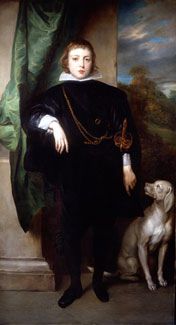
Young Rupert and his Weimaraner

Prince Rupert of the Rhine
1619 - 1682
I asked for a sign whether I was Rupert in a past-life. Later that day, I started reading a biography on Rupert and saw that his family was ejected from Prague, so they took refuge in The Hague, Netherlands. Then I went back to my computer to find a Facebook friend request from someone living in The Hague. That's the only time anything regarding The Hague has come to my attention. Coincidence or synchronicity?
MARTIN FROBISHER?
In August of 2013, my wife said to me one morning, "I had the word Frobisher coming to me when I woke up this morning. Who or what is a Frobisher?" I was intrigued since some years before I had looked into the life of Martin Frobisher as one of my possible past lives. So I asked the universe to give me a sign. Late that same day, my wife said, all excited, "I just saw a TV show with a main character named Frobisher. Isn't that strange?" Indeed. Coincidence or synchronicity?
Frobisher, an Englishman born in 1535, was an adventurer, explorer and admiral. He married Isabel Richard and then the daughter of Baron Wentworth, Dorothy. In the 1560's, he sailed to the Guinea coast of Africa and later conducted privateering operations against the French in the English Channel. In 1569, he fought as a soldier against the Irish. In the 1570's, Frobisher conducted three exploration voyages to what is now northern Canada around Baffin Island and what is now called Frobisher bay, looking for gold or the fabled northwest passage. He didn't find that, but he did find what he thought was gold and shipped 200 tons of it back to England. It turned out to be "fools gold", or iron pyrite. After that, in the 1580's, he sailed as a Vice Admiral under Sir Francis Drake to the West Indies and later to the Azores to attack Spanish shipping. When the Spanish Armada attempted to invade England, Frobisher was one of the four squadron leaders who defeated them. He was knighted for his heroics. Eventually, Frobisher was killed in 1594 during an attack on a Spanish fort at Brest, France.
Frobisher reminds me in some respects of John Cutts' and Prince Rupert's biographies. And I've always had a fascination for the northern Canadian islands and mining, which is why I obtained a degree in geology and wanted to go into hard rock mining.
Considering that it was my wife who had the name and synchronicity of Frobisher come up, perhaps he was one of her past lives.


Frobisher Me
1535 - 1594
MEDIEVAL PERIOD
COLIN CAMPBELL OF GLENORCHY?
At first, having had a dream in which the name James IV appeared, I figured I might have been James IV, the King of Scotland. However, I found out that an English woman born in 1929, A.J. Stewart, remembered being James IV and even brought investigators to the spot on the Flodden battlefield where the king died. Looking into James IV, since I dreamed about him, I discovered that he appointed as Lord Chancellor Sir Colin Campbell, 1st Earl of Argyll. He was born in 1433 and died in 1493. What shocked me was that I found out Campbell's uncle (a Knight Templar crusader dubbed "the black knight of Rhodes") and the man who raised him, also named Sir Colin Campbell, but of Glenorchy (lived about 1410 to 1489), built Kilchurn Castle starting in about 1440 and that's where the future chancellor, his nephew, was raised. Actually, it was his wife, Margaret, who oversaw construction while Colin was off crusading. By coincidence or synchronicity, the street I live on is named Kilchurn. Colin the Crusader also built Inverary Castle for his nephew the future chancellor. Oddly, my wife has a love affair with Scotland. Might she have been Isabella Stewart, the wife of the Colin Campbell of Glenorchy? Sometimes I call her Isabella because of her love of Italian food. Thinking I might have been one of the two Sir Colin's, I asked for a sign. Seconds later, my wife said, out of the blue, "How do you spell Colin?" It seems she was texting a friend who has a child named Colin. Coincidence or synchronicity? I did dream about James IV, so it seems there was a connection with Colin the Chancellor.
CHARLEMAGNE?
Looking for other clues, I remembered that many years ago under self-hypnosis, my arms would automatically move without my volition and I would "see" a globe with a cross on it in my left hand and a sword in my right. I never knew what that meant, but eventually I did look it up and found the globe with a cross is called a Globus Cruciger, and it symbolizes Christ's dominion over the world. Many Christian monarchs, starting with the Roman emperor Constantine the Great, are shown with the Globus Cruciger, but they all have a sceptre or staff in their right hand. There aren't many shown with a sword in the right hand.
Those shown with a sword and Globus Cruciger include Holy Roman Empire Kings Heinrich II (also known as St. Henry after his canonization), his son, Heinrich III, Wenceslas IV, and Frederick II. Also, William the Lion, King of Scotland, King of Cyprus, Peter I de Lusignan (also known as Peter I of Cyprus), and Tudor King of England Edward VI. All of the British kings from William the Conqueror to Richard I the Lion Heart also show themselves on their state seal with a sword and Globus Cruciger.
Perhaps the most famous of those shown with the Globus Cruciger and a sword is Charles the Great, a.k.a., Karl der Grosse or Charlemagne. He is considered the father of Europe, being the first to unify most of Western Europe after the Roman Empire. Charlemagne emphasized learning and culture, even for women and had a great sense of humor. He was a devout Christian who spread the religion. Interestingly, he was so possessive of his many daughters that he never allowed any to marry (although one had children illegitimately by one of Charles' aides). Robert E. Lee, who also had a great sense of humor, was also very possessive of his daughters and none ever married. These pictures all show Charlemagne with not only the Globus Cruciger and sword, but also a beard. He didn't actually have a beard but did have a mustache.


Emperor Charlemagne
I was reading a biography of Charlemagne in August 2018 and wondered again, if he was one of my past-lives. Then I went online to Facebook and was startled to see a picture of Charlemagne (the one in the center above) on my page. Synchronicity?
(Interestingly, in the US Capitol building dome there's a fresco mural called "The Apotheosis of Washington." Apotheosis is the exaltation of something, usually a man, to the God state. Washington is shown among the classical Gods, and he has a sword in his left hand and his right hand is making a gesture similar to the one I did. The difference is that his sword is pointing down as is his hand gesture. Presumably, since he's in heaven, his gestures are pointed downward towards the Earth.)
HERACLIUS?
Heraclius, born in 575, was an emperor of the Byzantine Empire who reigned from 610 to 641. He is considered one of the greatest Byzantine emperors. He overthrew his predecessor, the tyrannical and corrupt usurper Phocas who had murdered his predecessor and his family. He then had to defend the empire against the Sasanian Empire of the Persians, initially losing. But after reforming the Army, he drove the Persians back and defeated them in a brilliant campaign. The empire was also threatened by various Slavic tribes and the Turkic Avars who he eventually converted to Christianity. The main problem came in the form of Mohammed and the Arab armies that defeated him when a sandstorm blew in the face of the Romans (as they called themselves). The Muslims didn't conquer the Byzantines since they were eventually stopped, but they did overrun a large portion of the empire. Heraclius is credited with reforming the government and the military and ending religious disputes, as well as changing the official language from Latin to Greek. He is considered a brilliant military commander as well as a very humane person in keeping with his devout Christianity. He treated prisoners of war well and even released them if he couldn't take care of them.
I was reading an account of the Byzantine empress Irene and wondering if I had a life in that era. I had previously known under hypnosis that I was in the crusades but never knew who I might have been. But as I was reading abut Irene, I got a text message from my daughter showing a gold coin minted by Heraclius. I was struck by the coincidence and timing, especially since she had never sent me anything like that before. I looked up Heraclius and found that when the Persians conquered Jerusalem, Heraclius, clad as a penitent and carrying an image of the Virgin Mary, led his army to take back the holy city. He led what some historians consider the First Crusade, even if it was against Zoroastrians and not Muslims. So was it synchronicity?


Heraclius
ANCIENT PERIOD
ASSOCIATE OF JESUS?
I once was hypnotized by my brother who asked me to come up with a symbol that was important to me. I saw Jesus on the cross and for some reason, it sent me into a fit of sobbing. I was truly grief stricken and kept thinking how cruel it was of God to let such a good man suffer like that. For some reason, I thought I might be Mary Magdalene and knew myself as his wife. I thought that was weird, but did ask for a sign. Shortly thereafter, I went to see a movie entitled "All About Steve" in which the main character, played by Sandra Bullock, says her name is Mary Magdalene Horowitz. Shortly after that, I went to the airport and found a group at the gate that was returning from Europe where they went on a Magnificat Tour. They all had a picture of the Virgin Mary attached to their carry-on luggage. As I pondered that, a group of French tourists arrived and instead of finding their own area, proceeded to surround me. Legend has it that Mary Magdalene fled to France.
I'm not sure if Magdalene is the person, of course. I once
had a psychic tell me I was Barnabas, the companion of St. Paul, and
that I was the Virgin Mary's cousin. She said I made beads for a living
and gave a string to Mary, thus making the first Rosary. I'm a bit dubious about that one, too. It appears, though, that I knew Jesus somehow in a previous life.
According to the "Sleeping Prophet", Edgar Cayce, Mary Magdalene reincarnated as his own secretary, Gladys Davis.
There's also the possibility of "Doubting Thomas", who according to the Acts of Thomas, was the twin of Jesus. Thomas does, after all, mean twin in Hebrew. Thomas went to India and met Jesus in Taxila. I've been to Taxila and was told Jesus studied Buddhism there before returning to Israel and his crucifixion. I once had a vision of myself as an old man with white hair wearing a robe walking down a road in what appeared to be India. But I have nothing to indicate this possibility is true.
ZEUS?
Oddly, I received a message from a lady who claimed that she was a reincarnation of the Greek goddess named Artemis. She said that the Greek gods were real and were aliens. What's more, she said that I was not only a split soul with President Donald Trump and, like Donald, a reincarnation of Washington, but that I was once the Greek God, Zeus. Needless to say, this struck me as highly improbable. However, I keep an open mind and decided to look into it. To begin with, I asked the universe for a sign as to whether I was Zeus. The next day, my son called and happened to mention that he was babysitting a friend's dog named Zeus. Coincidence or synchronicity? Anyway, looking further, I came across a book called "Spiritual Interview with George Washington", written in 2016 (before the US election) by a Japanese "holy man" named Ryuho Okawa. In it, Okawa channels Washington as others ask him questions. Among the statements "Washington" says is that he's reincarnated as Donald Trump and when asked about his past lives, says he was a god in Europe, among other places such as India. He didn't specify which god, however. Now Washington says he's the God of the United States. Nice work if you can get it.
CARNEADES?
In January 2012, I hypnotized a friend of my son's and asked, as I usually do, whether he knew me in a previous life. He went back to the robe and sandal period and said I was his teacher and, because he had no family, was a surrogate father. The teacher taught skepticism, which made him unpopular with religious authorities and so there was a lot of tension and the young man avoided looking at soldiers. The teacher eventually killed himself, although my subject didn't know how or when. From his description of the city and countryside, I'd say he was in Cyrene or Alexandria and the teacher was Carneades, the principle philosopher of the "Academic Skepticism" school. The pupil was probably Clitomachus, his close friend and successor. They lived in the second century BC. Interestingly, Carneades taught that we can't know the truth about anything. All we can do is assign probabilities and act accordingly. That's more or less my philosophy in life and the governing philosophy of an intelligence analyst. Carneades lived to an old age, but because of his infirmities, said he wanted to kill himself by drinking poison. Nobody knows if he really did.
Carneades
OTHERS?
Back around 1996, I hypnotized a co-worker who said she saw she and I as students in an old robe and sandal mystery school. A forbidden love affair between us was discovered and she killed herself. This lady also saw the two of us as a king and queen in ancient East Anglia, Britain.
A lady who claims to remember being Sophie, the daughter of France's King Louis XVI, says that while meditating, she saw me as her father in that lifetime. I don't know about being Louis, but I do have a private horror of being guillotined.
I once had a massage and while relaxing, saw myself as an old American Indian sitting in the snow, dying, and wondering where the buffalo went. I once wrote a poem about dying alone in the snow years before.
COMMENTS
Obviously, the odds of my having been one of these historical figures, much less all, is exceedingly small. I don't feel out of the ordinary or someone special, so as mentioned previously, I don't make the claim to have been any of them and present here only the process by which I came up with the possibilities. This would only have worked if the past personalities were known in history. A lifetime spent in average lives would not leave much of a record, if at all. So why even consider them as possibilities?
The main reason for suspecting that any of these lives were my actual past incarnations is that of the signs which I deemed significant. While finding commonalities is interesting, they can also be cherry picked, leaving what doesn't match aside.
When conducting my search, there were many personalities who seemed like a good match based on commonalities, so I asked for a confirming sign only to receive nothing. What is presented above is merely the most significant. In some cases, I did get what could be construed as a sign but it was not convincing enough. For example, I asked if I was Thomas a Becket and then read about a kid whose mother painted his toe nails. His name was Becket. I took that as a mere coincidence. A sign needs to be startling or really unlikely to be convincing. But how many kids are named Becket?
In some of my cases, it was my wife who gave me the sign, which makes me wonder if her subconscious was reading mine and then responding accordingly. That seems unlikely because in most cases, she was prompted by an external stimulus, such as reading a book.
It's also interesting that some of the signs had to be set up in advance before I asked for them. The car with the "4Rosy" license plate had to have been on it's way down I-95 before I asked for a sign. It's as if the universe knew in advance when I would ask and arranged the answer. That may not be typical.
So, was it a coincidence that I found the young lady who appears to have been Ann Willing Bingham? Or that I was told by a medium that I was going to be provided with information on my past lives? It appears that all this was for a purpose, but what that purpose is, I still haven't figured out.
You may also have noticed that psychics are not the most reliable method of identifying past lives. It's not that they're necessarily trying to deceive you, it's just that they report on what they see and that may be accurate or just imagination. I had one psychic give me a past-life scenario only to realize it was the plot of a movie I had seen. I regard psychics as possibly partially right, and it behooves you to discern what is likely and what isn't. They provide clues that you can follow even if all the information isn't correct. One of the ironies is that people claim psychics will tell you that you were someone famous in a past life as a way to ingratiate themselves. In my experience, psychics are loathe to claim you were someone famous just because of that. They usually say you were associated with some famous person rather than say you were that person. The "landmark" theory is that the person who was once associated with the famous person wants to identify with their fame and so remembers being that famous person in the past life. Then again, according to the late Dolores Canon, before we incarnate, we study the life of some famous person we want to emulate and then when incarnate, remember that life as our own. Of course, in my case, I have no memories of past lives.
Another oddity is that I received signs indicating simultaneous lifetimes. Could I have been both Rosecrans and Lee? If you think of the soul as you would a body, confined to one identity, it's impossible. But if the soul is just energy and consciousness, that is, mind, there's no reason why it couldn't divide or, as in the quantum physics of photons, be either a wave or a particle depending on how it's viewed. The soul may be a wave (potentiality) but is viewed as a particle (individuated) from the mind's perspective. Several authorities claim we can be in more than one body, including people who have had near death experiences and identified who else they were on the earth plane. So at least in regard to double incarnations, it's possible. In fact, the Transcendentalists and Theosophists say there's an "Oversoul" that overseas individual souls somewhat like bays in an ocean. Could all the possibilities I examined above be from the same Oversoul and that's why I associated them with my past lives? I really don't know, but the Oversoul theory isn't the only one.
I once had a psychic tell me that I'm not from this world originally. My soul evolved in the Arcturus star system. I also had another psychic tell me that I have "alien" energy. I took that with a grain of salt until I arrived at the Monroe Institute and my roommate took one look at me and said, "You're from Arcturus." I asked him how he knew, and he said he was from there, too, and his evidence was certainly interesting as to why he believed himself an Arcturan "Starseed." He said the home planet is arid and rocky, with mountains and mesas, a reddish sky, and clay like houses. That sort of floored me because I once had a very realistic dream of flying over just such a place.
In February 2020, I stepped outside around 3 a.m., and as I usually do, watched the sky. It was overcast, so I didn't expect to see anything. But then, a hole appeared in the clouds and a bright star shone through, all alone in the sky. Turned out to be Arcturus. It happened again the following May when I had the urge to go outside and see if the sky held any signs. Turns out it did. There was a V-shaped cloud, the only one in the sky, with sort of frilly edges. It reminded me of angel wings. In the center of the V was Arcturus, the only star visible in the sky. Synchronicity or just strange coincidence?
Meanwhile, another person at the Monroe Institute said she saw me floating around, sort of looking like an astronaut, while she was in a trance. On another night she saw me floating around looking like I was wearing a mask. As I understand it, Arcturians have a sort of group soul, or at least a group consciousness. Perhaps that's why I seem to have been more than one person at a time. Perhaps I'm just aware of other Arcturians. Who knows? Maybe all of the possibilities I listed above are part of the same soul group. Interestingly, Gen. George S. Patton had a yacht named "Arcturus." Considering his many incarnations as a warrior, was he part of the Arcturian soul group? Do we know each other in some other realm? (I do know a fellow who claims to be the reincarnation of Patton in this life.)
A few years ago, I asked the universe if I could have a sign as to whether I'm from some other star system. The next day, I got into the car, turned on the radio and heard the song, "Learning to Fly" by Pink Floyd playing. The next day, I got into the car again, turned on the radio and the same song was playing. Late that night, around midnight, I went outside and for some reason, suddenly looked straight up just as a bolide exploded, quite spectacularly, above my head. I asked if this was a sign, and my head started tingling. The lyrics to the song, "Learning to Fly" go like this, and they're quite appropriate:
Stretched to the point of no turning back
A flight of fancy on a windswept field
Standing alone my senses reeled
A fatal attraction is holding me fast,
How can I escape this irresistible grasp?
Can't keep my eyes from the circling skies
Tongue-tied and twisted, just an earth-bound misfit, I
Ice is forming on the tips of my wings
Unheeded warnings, I thought I thought of everything
No navigator to find my way home
Unladened, empty and turned to stone
A soul in tension -- that's learning to fly
Condition grounded but determined to try
Can't keep my eyes from the circling skies
Tongue-tied and twisted just an earth-bound misfit, I
Above the planet on a wing and a prayer,
My grubby halo, a vapour trail in the empty air,
Across the clouds I see my shadow fly
Out of the corner of my watering eye
A dream unthreatened by the morning light
Could blow this soul right through the roof of the night
There's no sensation to compare with this
Suspended animation, a state of bliss
Can't keep my mind from the circling skies
Tongue-tied and twisted just an earth-bound misfit, I
In the official video a Native American boy puts a feather into an arm band and turns into an eagle as he jumps off of a cliff. A couple of years after the first incident, I was watching the video and wondered if I'd get another sign. A couple of hours later I walked out of my house and found a large feather on my driveway. No other feathers or other remains of a large bird were found. A synchronicity?


Me and the feather. Learning to Fly
In October 2013, I wondered if, given all my lifetimes as a warrior, that I was connected somehow to the Archangel Michael, whose name means "Who is like God?" He's God's warrior who battles Satan. So I asked for a sign. That night I had a dream. In it, I was with some other Navy officers dressed in summer whites and we came to the office of our commander, a full Admiral. I noticed from my shoulder boards that I was a Vice Admiral, which is the second highest flag rank just below a full Admiral. A pretty secretary ushered us into a room where the commander sat behind a desk talking to some aides. I then noticed that when I looked at my arms, I was in the winter blue uniform (the one with the rank on the sleeves) but I had my sleeves folded over to hide my rank (one broad stripe and two thin stripes), making me look like an ensign (one thin stripe). When I looked at the commander, he had long, curly hair down to his shoulders and a beard. He also had a shawl over his shoulders, making him look like pictures of Jesus. I looked at the secretary, who was sitting behind me, and said something about how odd he looked for a navy officer. She just smiled and said something I don't remember. But I said in return that I was being held in reserve.
I didn't immediately associate the dream with my request for a sign, but when it did occur to me, it seemed that the Admiral might have been Michael or even Jesus and that I am in reserve, hiding my rank while on Earth. Could it be I have a role in the future during the final battle between Michael and Satan? Back when I was taking a hypnosis course, the instructor hypnotized us as a group. But I was so tired I just fell asleep. Afterwards, another student told me that he saw an angel come down and take me by the hand, trying to lift me out of my body. I shook the angel off, not wanting to go. Maybe I missed an important meeting! Anyway, all I know is that I'm a bit old to be a warrior at this point. I really was a Navy Reserve Lieutenant Commander before retiring, so perhaps the dream reflected that.
In November 2018, I was reading a book in which it talked about the Archangels, especially Michael, and how they contact you. Later that evening, I took my dogs for a walk and across the street from my house found a laminated card lying on the sidewalk. Picking it up, I saw a picture of St. Michael slaying the Devil. That night, as I was going to sleep, I heard the words in my head, "You are under Michael's protection."
A couple of weeks later, my wife and I went to a grocery store and the bill was $111.74. On the way home, we realized that we forgot some items, so we stopped at another grocery store and the bill there was $11.74. Coincidence or synchronicity? 7+4=11, so in a way, each bill was all ones. I notice that 11, 111 and 74 all have a variety of interpretations both in numerology and in Gematria (the number of Jesus, Messiah, cross and oddly, Lucifer). So what did it mean? Perhaps, some day I'll know. In the meantime, I have periods when I see 1:11 or 11:11 on the clock quite frequently.
So it appears that I'm possibly some kind of warrior soul, perhaps associated somehow with Michael. Years before, I came across the definition of a soul that's called a Knight Paladin. It goes:
I had another dream in which someone said my real name is "Thunder Egg." I wondered what that is and looked it up. Turns out that it's the egg laid by the mythical Thunderbird of Native American lore. The Thunderbird is considered to be the servant of the Great Spirit and a wrathful warrior. They (or in some traditions, a singular entity) delight in fighting and doing great deeds. In one story, the Thunderbird destroys Reptilian monsters. In another, he destroys evil snakes trying to take over the Earth and devour mankind. Interestingly, in some stories, the Thunderbird can shape-shift into a human being and intermarry. I find the story of the Thunderbird to be essentially parallel to that of the Knight Paladin. If, then, I'm a Thunder Egg, does that mean I've yet to hatch in this lifetime? Or that I'm being held in reserve? And does the reptilian monster or snake the Thunderbird battles correspond to the so-called "Reptilians" that come from the Constellation Draco and are supposed to be trying to enslave mankind? Does being originally from Arcturus make them the enemy I'm supposed to fight?
In yet another dream, I saw a scroll about me and it said, as best I remember, that a soul like this comes along only every few centuries. Since I seem to incarnate quite frequently, I don't know how this would apply to me. In any case, if true, I'm a definite underachiever! More likely, my subconscious has an even bigger ego than my waking conscious! For the most part, in this life, I'm not aggressive, but real injustice, evil and cruelty infuriate me.
So who knows who or what I really am, besides a possible narcissist! And how accurate is any of this is? It makes an interesting story, at least for me. But I'm apparently not alone. Here's a poem by another believer in his warrior mentality:
"Through a Glass, Darkly"
General George S. Patton, Jr.
Through the travail of the ages,
Midst the pomp and toil of war,
I have fought and strove and perished
Countless times upon this star.
In the form of many people
In all panoplies of time
Have I seen the luring vision
Of the Victory Maid, sublime.
I have battled for fresh mammoth,
I have warred for pastures new,
I have listed to the whispers
When the race trek instinct grew.
I have known the call to battle
In each changeless changing shape
From the high souled voice of conscience
To the beastly lust for rape.
I have sinned and I have suffered,
Played the hero and the knave;
Fought for belly, shame, or country,
And for each have found a grave.
I cannot name my battles
For the visions are not clear,
Yet, I see the twisted faces
And I feel the rending spear.
Perhaps I stabbed our Savior
In His sacred helpless side.
Yet, I've called His name in blessing
When after times I died.
In the dimness of the shadows
Where we hairy heathens warred,
I can taste in thought the lifeblood;
We used teeth before the sword.
While in later clearer vision
I can sense the coppery sweat,
Feel the pikes grow wet and slippery
When our Phalanx, Cyrus met.
Hear the rattle of the harness
Where the Persian darts bounced clear,
See their chariots wheel in panic
From the Hoplite's leveled spear.
See the goal grow monthly longer,
Reaching for the walls of Tyre.
Hear the crash of tons of granite,
Smell the quenchless eastern fire.
Still more clearly as a Roman,
Can I see the Legion close,
As our third rank moved in forward
And the short sword found our foes.
Once again I feel the anguish
Of that blistering treeless plain
When the Parthian showered death bolts,
And our discipline was in vain.
I remember all the suffering
Of those arrows in my neck.
Yet, I stabbed a grinning savage
As I died upon my back.
Once again I smell the heat sparks
When my Flemish plate gave way
And the lance ripped through my entrails
As on Crecy's field I lay.
In the windless, blinding stillness
Of the glittering tropic sea
I can see the bubbles rising
Where we set the captives free.
Midst the spume of half a tempest
I have heard the bulwarks go
When the crashing, point blank round shot
Sent destruction to our foe.
I have fought with gun and cutlass
On the red and slippery deck
With all Hell aflame within me
And a rope around my neck.
And still later as a General
Have I galloped with Murat
When we laughed at death and numbers
Trusting in the Emperor's Star.
Till at last our star faded,
And we shouted to our doom
Where the sunken road of Ohein
Closed us in it's quivering gloom.
So but now with Tanks a'clatter
Have I waddled on the foe
Belching death at twenty paces,
By the star shell's ghastly glow.
So as through a glass, and darkly
The age long strife I see
Where I fought in many guises,
Many names, but always me.
And I see not in my blindness
What the objects were I wrought,
But as God rules o'er our bickerings
It was through His will I fought.
So forever in the future,
Shall I battle as of yore,
Dying to be born a fighter,
But to die again, once more.
